
Medically reviewed by Dr Dhivian, MBBS, MMed (Family Medicine), Accredited Family Physician, Angsana Medical
The short answer
Erectile dysfunction is a persistent difficulty getting or keeping an erection firm enough for sex. Occasional trouble is normal. It is increasingly seen in younger men, often for psychological or lifestyle reasons, and it is common and treatable.
What is erectile dysfunction
Erectile dysfunction, often shortened to ED, is the persistent difficulty in getting or keeping an erection firm enough for satisfying sex. The key word is persistent. Almost every man has an off night at some point, and that is not a medical problem. It becomes erectile dysfunction only when the difficulty keeps happening over several weeks or months, often enough to bother you or your partner.
To understand what erectile dysfunction is, it helps to know that an erection is a surprisingly coordinated event. It depends on healthy blood vessels, working nerves, balanced hormones, and a relaxed, willing state of mind, all at once. Because so many systems are involved, a problem in any one of them, physical or psychological, can affect the result. That is why ED is not a sign that something is fundamentally wrong with you as a man. More often it is a signal that one part of this chain needs attention.
The line between an occasional difficulty and a persistent pattern matters. A single evening when things do not go to plan, perhaps after a long week, a few too many drinks, or a poor night of sleep, is extremely common and usually resolves on its own. A persistent pattern shows up most of the time and often brings worry that makes the next attempt harder. This loop of difficulty and anxiety is one reason men feel the problem is worsening, when in fact it is treatable once the cause is understood. ED is common, men are far from alone in experiencing it, and speaking to a doctor is an ordinary, private, sensible step.
Symptoms and when it is worth seeing a doctor
The main erectile dysfunction symptoms are straightforward. They include difficulty getting an erection, difficulty keeping one long enough for sex, and sometimes a noticeable drop in sexual desire. Some find erections are softer than before, or do not happen as reliably in the morning. These signs can appear gradually or suddenly, and the pattern itself is a useful clue for your doctor.
As a general guide, it is worth seeing a doctor if the difficulty has lasted more than a few weeks, is happening most of the time, is causing you distress, or is affecting your relationship. There is no need to wait until things feel severe, as the underlying factors respond better when addressed sooner.
One point deserves real emphasis, because it is why doctors take ED seriously rather than treating it as purely a bedroom issue. Erectile dysfunction can sometimes be an early warning sign of an underlying cardiovascular or metabolic problem. The blood vessels that supply the penis are small, so they can show the effects of poor vascular health before the larger arteries of the heart do. In some men, ED appears a few years before conditions such as heart disease, high blood pressure, high cholesterol, or diabetes are diagnosed. This is not a cause for alarm, but it is a good reason not to ignore a persistent change.
So you should consider seeing a doctor sooner if the ED comes alongside other symptoms or risk factors. These include chest pain or breathlessness on exertion, unusual tiredness, increased thirst or passing urine more often, a family history of heart disease or diabetes, or an existing diagnosis of high blood pressure, high cholesterol, or raised blood sugar. In these cases the erectile difficulty may be one piece of a larger picture. A family doctor can assess both the ED and your general cardiovascular and metabolic health in the same visit.
Why ED is increasingly common in younger men
It used to be assumed that erectile dysfunction was mainly a problem of older men. That picture has shifted, and doctors now see ED more often in men under 40. Greater awareness and willingness to talk about it play a part, but genuine lifestyle and psychological trends are also at work. Understanding them is the first step in knowing how to prevent erectile dysfunction or improve it.
In younger men, the causes of erectile dysfunction are most often psychological rather than physical. Everyday stress from work, finances, or studies can interfere with arousal. Performance anxiety is especially common. A single difficult experience can create worry about the next one, and that worry itself makes an erection harder to achieve, which feeds the cycle. Low mood and relationship strain contribute too. For some men, heavy use of pornography can shape expectations so that real intimacy feels less stimulating by comparison. None of these are character flaws. They are common, very human, and they respond well to the right support.
Lifestyle and vascular factors are the second major group, and they matter more in younger men than many expect. Smoking damages the small blood vessels that erections depend on. Regular heavy drinking, being overweight, a sedentary routine, and consistently poor sleep all reduce blood flow and hormone balance over time. These factors often cluster together and build up quietly. Encouragingly, they are also some of the most changeable.
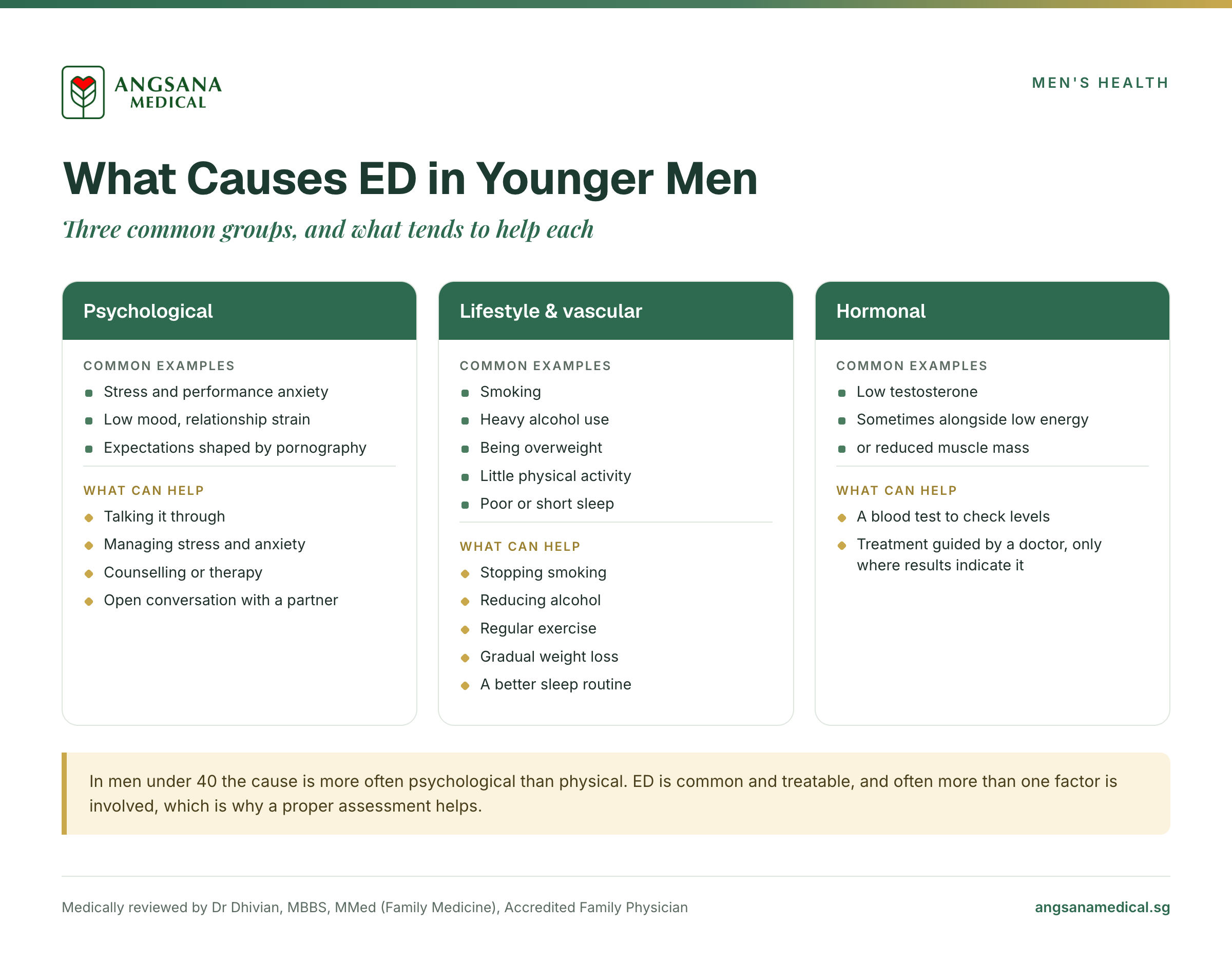
Hormonal factors make up the third, less common group. Low testosterone can reduce both desire and erectile function, and it is more likely alongside low energy, low mood, or reduced muscle mass. It is far from the usual explanation in young men, but it is simple to check with a blood test. The table below sets out these three groups and what helps.
Common causes of ED in younger men
| Category | Examples | What can help |
|---|---|---|
| Psychological | Stress, performance anxiety, low mood, relationship strain, expectations shaped by pornography | Talking it through, managing stress and anxiety, counselling or therapy, open conversation with a partner |
| Lifestyle and vascular | Smoking, heavy alcohol use, being overweight, little physical activity, poor or short sleep | Stopping smoking, reducing alcohol, regular exercise, gradual weight loss, better sleep routine |
| Hormonal | Low testosterone, sometimes alongside low energy or reduced muscle mass | A blood test to check levels, and treatment guided by a doctor only where results indicate it |
Can you prevent or improve it
For many men, especially younger men, the most powerful changes are not medical at all. They are the everyday habits that protect your blood vessels, balance your hormones, and steady your mind. Because the same factors that cause ED can often be eased, the question of how to prevent erectile dysfunction has a genuinely hopeful answer. None of these steps is a quick fix or a guarantee, but together they give the body the conditions it needs to work well. The lifestyle changes that tend to make a real difference are practical and well within reach:
- Stopping smoking, which is one of the single most helpful steps because smoking directly harms the small blood vessels involved in erections.
- Keeping alcohol moderate, since cutting back on heavy or regular drinking can improve both function and sleep.
- Moving regularly, with aerobic activity such as brisk walking, running, cycling, or swimming to support blood flow and weight.
- Working towards a healthier weight, where even a modest, steady reduction can help.
- Protecting your sleep and managing stress and mood, which addresses one of the biggest drivers in younger men.
Relationship and psychological factors deserve their own mention in this age group. Honest conversation with a partner can take a surprising amount of pressure off and often breaks the anxiety loop that keeps the problem going. Where stress, anxiety, or low mood are part of the picture, structured support helps, and our mental health support can be a sensible starting point, on its own or alongside a review of the physical factors.
It is also worth noting that erectile dysfunction is not the same as premature ejaculation, though the two can occur together and can both be helped. If you are unsure which one you are experiencing, a doctor can sort that out gently in a consultation.
 A private, confidential consultation about erectile dysfunction with a doctor at Angsana Medical in Singapore.
Treatment options and what a doctor visit looks like at Angsana
If lifestyle steps alone are not enough, there are several treatment options, and the right choice depends on what the assessment finds. The most foundational is the lifestyle and psychological side already described. Where stress, anxiety, performance pressure, or relationship factors are involved, psychological counselling can be effective on its own or alongside other measures. This is often where treatment begins for younger men.
For some men, doctors may consider a class of oral medications known as PDE5 inhibitors. As a class, these work by improving blood flow to the penis in response to arousal, and they are generally well tolerated and effective for many men. They are prescription-only, so they are not suitable for everyone and are chosen by a doctor after a proper assessment of your health and any other medications you take. As with any medicine, possible side effects exist, and these are discussed openly in the consultation so you can make an informed decision. They are one option among several, chosen only where appropriate.
Where a blood test shows it is indicated, testosterone optimisation may be discussed. This is only relevant when results and symptoms point to genuinely low levels, and it is managed and monitored by a doctor rather than started on assumption. Another option some men ask about is shockwave therapy, which uses low-intensity sound waves and may be considered in selected cases for its regenerative effects. As with every option, suitability is individual, and the benefits and general considerations are weighed with you.
A visit at Angsana is designed to feel calm and unhurried. Our family doctors take a full history, ask about lifestyle, mood, relationships, and general health, and check for any underlying cardiovascular or metabolic factors linked to ED. Where useful, simple tests such as blood pressure, blood sugar, cholesterol, or hormone levels may be arranged. Your doctor then explains the likely contributing factors and talks through suitable options. We do not promise guaranteed results, because honest medicine does not work that way. What we can say is that addressing the underlying causes gives the best chance of improvement, and that understanding what is happening is itself a meaningful step.
The most important step is starting the conversation. You can read more on our erectile dysfunction service page, or explore our wider men's health services.
Talk to a doctor, privately and without judgement
ED is common and treatable, and a short consultation can give you clarity on what is going on and what can help. Our family doctors handle these conversations sensitively and confidentially.
Frequently Asked Questions About Erectile Dysfunction
Is it normal to have ED in your 20s or 30s?
Occasional difficulty getting or keeping an erection is very common at any age and is usually nothing to worry about. It can follow a stressful week, poor sleep, alcohol, or anxiety in a new relationship. It only becomes erectile dysfunction when the difficulty is persistent over several weeks or months and starts to affect you or your partner. In younger men the cause is more often psychological than physical, so it is well worth seeking help early, and there is no reason to feel embarrassed about doing so.
What causes erectile dysfunction in young men?
In men under 40 the most common causes are psychological, including stress, performance anxiety, low mood, relationship strain, and habits around pornography that can shape expectations. Lifestyle and vascular factors also play a large part, such as smoking, heavy alcohol use, being overweight, lack of exercise, and poor sleep. Hormonal causes such as low testosterone are less common but worth checking. Often more than one factor is involved at the same time, which is why a proper assessment helps.
Can erectile dysfunction be reversed?
Many causes of erectile dysfunction are treatable and often improve, especially when they are addressed early. Lifestyle changes such as stopping smoking, cutting back on alcohol, exercising, and improving sleep can make a meaningful difference. Where anxiety or relationship factors are involved, counselling helps. Where a medical cause is found, a doctor can discuss appropriate treatment. Outcomes depend on the underlying cause and on the individual, so it is best to have an assessment rather than assume the worst.
When should I see a doctor about ED?
Consider seeing a doctor if the difficulty has lasted more than a few weeks, is happening most of the time, is causing you distress, or is affecting your relationship. You should also see a doctor sooner if you have other symptoms such as reduced sex drive, chest pain on exertion, unusual tiredness, or known risk factors like diabetes, high blood pressure, or high cholesterol, because erectile dysfunction can sometimes be an early sign of an underlying health issue.
Does ED always mean low testosterone?
No. Low testosterone is only one of several possible causes, and in younger men it is far from the most common one. Psychological factors and lifestyle or vascular factors are more frequent. A doctor may arrange a blood test to check your testosterone level if your symptoms suggest it, but a normal result does not mean nothing can be done. The right approach depends on what the assessment actually finds, not on a single assumption.